Every field shows the sentence it came from.
Assay reads a prospect’s own website, scores the fit, and attaches to every field the exact sentence it was read from and the page that sentence is on.
A field it cannot quote ships marked unproven. Nothing is invented and nothing is quietly dropped.
Latest public run: 16 companies read for $0.80. 8 rejected. 27 of 110 fields thrown out because the quote was not on the page.
No customers yet. Nothing on this page is a customer result.
| Score | Company | Verdict |
|---|---|---|
| 92 | HubSpot hubspot.com | strong |
| 92 | Demandbase demandbase.com | strong |
| 92 | Lusha lusha.com | strong |
| 92 | ZoomInfo zoominfo.com | strong |
| 88 | Seamless.AI seamless.ai | strong |
| 82 | 6sense 6sense.com | strong |
read hubspot.comquote ""found true on the page, character for characterwhat they sell "Customer platform with marketing, sales, and service software built on a Smart CRM"
One company, read and checked.
A scripted demonstration of the real mechanism. Not a customer result. Press replay to watch it check itself.
We are hiring two Sales Development Representatives to help us reach mid-market revenue teams in North America.
Enriched data arrives without its evidence.
Outbound agencies resell data they cannot see inside. That costs them twice.
First, the bill. Per-credit tools charge for every enrichment, including the ones that fail, and the total moves 30 to 50 percent month to month with no line that explains why.
Second, the call. A client asks where a number came from. The only answer is a vendor’s name.
Credits that cannot be predicted, and claims that cannot be defended.
Reported jump: 4,000 to 6,000 US dollars in one month, with no change in client scope. Agency bills are reported to swing 30 to 50 percent month to month.
“Clay as a GTM orchestration tool is not worthwhile at any meaningful scale because of the actions costs. Simply running a handful of research prompts on say 5k people or companies and then syncing these to a sequencer costs hundreds of dollars, and that's when bringing your own API keys.”
“Tried Clay for prospecting and everything fell apart. Workflows froze, data was wrong, and credits vanished fast.”
“The credit model could be better; failed enrichments still burn credits, and we've blown through monthly credits early a couple of times.”
“If your SDR team expects to sign up and start prospecting on day one, Clay will frustrate them. It's a low-code data platform.”
Quoted from a September 2026 research pass over 30 cited sources. Sources are named in the file, not paraphrased here.
Other tools cite a source. Assay checks it, and shows you the ones that fail.
No tool in the sources shows the source sentence behind an enriched field, nor lets a user audit a claim back to the exact page sentence it was read from.
Ten tools were reviewed for the research. The sentence on the left is the finding, and the window it sits in is what a receipt looks like everywhere in the product: the words, then the page they came from.
| Question a client asks | Per-credit tools | Assay |
|---|---|---|
| Where did this come from? | A vendor name, or nothing | The sentence, and the page |
| Can I read it myself? | No | The url is on the row |
| What if the model guessed? | You find out from a bounce | The field ships marked unproven |
| What did this run cost? | Credits, worked out later | Dollars, while it runs |
| Can I take it in-house? | No, it is their platform | Yes, on the Own it plan |
The Receipt Rule
No quote, no field.
// before the search, both sides are folded
normalise("quote")
  · folds curly quotes
  · folds em dash
  · collapses whitespace
  · strips markdown emphasis
  · strips zero width
  · lowercases

// then it is on the page, or it is not
verified: true | false
score: > 44 needs a verified quote
- step 01
It reads the site. Only the site.
Up to three public pages the company published for anyone to read. No broker list, no bought database, no scraped person. If no page can be read, the company gets no score at all.
- step 02
It must quote before it can claim.
For every field, the model has to copy a sentence out of those pages, character for character. A field with no sentence behind it comes back empty. Empty is allowed. Invented is not.
- step 03
The Receipt Rule runs the check.
Each quote is searched for in the pages that were actually fetched. Curly quotes, dashes, spacing and case are folded first, so a real sentence is never failed on punctuation. Then it is on the page, or it is not.
- step 04
What fails the check is shown failing.
It is not deleted and it is not quietly fixed. The field ships with a red mark that says the sentence was not found. A score with no verified quote behind it is pulled down to 40 and marked no.
A real sentence with a curly apostrophe. A real sentence split by a line break. A real sentence the page wrapped in bold.
An invented sentence. A real sentence with one word changed. Two real fragments joined that were never next to each other. A quote shortened with an ellipsis.
25 checks. A gate that has never failed is not known to work, so it is fed things it has to reject.
The whole run is public. Check it.
A deliberately mixed list: 8 companies that fit the profile and 8 that could not. Run on 9 September 2026.
Well-known companies were chosen on purpose. If a reader cannot open the page and confirm the sentence, a receipt is worth nothing.
Assay found the 8. It also rejected Salesforce, which does sell to revenue teams, because the profile asked for 20 to 300 staff and the page said otherwise.
296 seconds, every call itemised
A tool reporting 100% would be a tool that had stopped checking.
{
  "companies": 16,
  "scored": 15,
  "unreadable": 1,
  "strong": 7,
  "no": 8,
  "claims": 110,
  "receipted": 83,
  "rejected": 27,
  "rate": 75%,
  "seconds": 296,
  "cost_usd": "0.80"
}
read only, no sign in
For comparison: independent 2026 testing put a finished lead on a per-credit tool between $0.50 and $3.00. The same 16 companies would be $8 to $48 there. This run was $0.80. Assay does not find contacts, and that is a real part of the difference.
Four things Assay does not do.
It does not send email.
Sending is domain warming, SPF, DKIM, inbox rotation and bounce handling. Get that wrong and a client's domain is burned, which does not undo. Keep Smartlead. Keep Instantly. Assay hands the row to them.
It does not find people.
No personal emails, no direct dials, no scraped profiles. It reads what a company published about itself. A contact tool is still needed for contacts, and the price reflects that.
It is not faster than a lookup.
Reading three pages and thinking about them takes about 20 seconds a company. A database lookup takes under a second. Assay sells a checked answer, not a quick one.
It has no customers yet.
No case study, no testimonial, no revenue. The only proof offered is a run that anyone can open and check, and it is linked above.
One price a month. It does not move.
A six-person agency reading about 2,000 companies a month was costed at $1,895 to $5,325 a month on a per-credit tool in the same research. Assay’s plans are set against that number. The first 10 accounts get the Agency plan at $199, locked for 12 months.
The Agency plan, for the first ten accounts. The price holds for twelve months.
- ✓Everything in Agency
- ✓2,000 companies a month
- ✓Price locked for 12 months
- ✓Ten accounts, then it closes
10 of 10 founding places left_
For one operator.
- ✓400 companies a month
- ✓1 seat
- ✓CSV export with receipts
- ✓Shareable read-only runs
For a team running client work.
- ✓2,000 companies a month
- ✓Unlimited seats
- ✓Webhook out to Make, n8n, Smartlead
- ✓Shareable read-only runs for clients
- ✓The cost ledger, per run and per company
- ✓Re-audit: check September's receipts against today's pages
For a firm that wants the machine in its own stack.
- ✓Everything in Agency
- ✓Runs in your own stack
- ✓Your own API keys, billed to you at cost
- ✓The pipeline handed over in Make or n8n so your team can read it
Billed monthly through PayPal. Cancel any time. A company that cannot be read does not count.
The ones that decide it.
q01Is this a Clay replacement?
No. Clay finds people and orchestrates a hundred providers. Assay does one job: it reads a company's own site and proves what it says about it. Most agencies would run both, and use Assay for the research layer where the bill hurts.
q02What happens when the model makes something up?
It gets caught, visibly. The quote is searched for in the pages that were fetched. If it is not there, the field is marked unproven in the app and in the CSV, and if nothing on that company could be proven, the score is pulled down and the verdict is set to no.
q03Why is the receipt rate not 100%?
Because the check is real. A model asked to quote will sometimes tidy a sentence, join two of them, or state something reasonable that the page never said. A tool reporting a perfect rate has either stopped checking or is checking something easy.
q04Is reading public websites legal?
Reading a page a company published for the public, and quoting it with a link back, is what search engines have always done. Assay stores no personal contact data and builds no person-level profile, which is where most of the risk in this category sits. This is not legal advice.
q05Can I run it in my own stack?
Yes, on the Own it plan. It runs on your keys, in your stack, and the pipeline is handed over in Make or n8n so a person on your team can read it without reading code.
q06Who is behind Assay?
Machines + Words (Pty) Ltd, a one-person company in Cape Town. Assay has no customers yet and does not claim any. Everything offered as proof on this page is a run you can open and check yourself.
The design system
A mirror. Every token here is already load-bearing on the website. If a colour is on this page and not on the site, the colour is deleted, not documented.
Eleven bands. Cream, white and pebble do the sectioning, with hairlines. No shadows on bands. No dark band: the dark surface is the terminal window, and it appears only where there is a receipt.
Assay reads a prospect’s own website, scores the fit, and attaches to every field the exact sentence it was read from.
Up to 3 public pages a company published for anyone to read. No broker list, no bought database, no scraped person.
We are hiring two Sales Development Representatives to help us reach mid-market revenue teams.
One filled button on a screen, and it is orange. Every other button is a ghost: a hairline, no fill. Hover goes darker, never lighter. No lip, no lift. Focus is a 3px orange outline, not a glow.
We are hiring two Sales Development Representatives.
Backed by leading investors and trusted by 500 teams.
Every ratio measured with contrast.py against the ground the text sits on. Body needs 4.5:1, large 3:1. Nothing set as body text is under 4.8:1. The vivid orange is 3.2:1 and is only ever a rule under a quote or one phrase at 30px and up.
Colour, and how little of it. Cream paper, one orange that annotates one phrase in a headline. The type pair: Inter for reading, JetBrains Mono the moment it turns to data.
The signature move: a dark code window is the proof. Hairlines separate layers, never shadows.
Hierarchy by size, not weight. Bands that float on the canvas with no card around them.
It looks like none of them because it is light where two of them are black, the dark window appears only where there is a receipt, and the orange is under one percent of the page. Took nothing else from any of them.
Night, same day: fingerprint.com’s home page became the gold standard for graphics and motion. Seven mechanisms were written down (design-loop/bar.md), three critics judged every round blind, and the page shipped when all three passed. Their object is the device and their second colour is blue; ours is the receipt and teal.
“We are hiring two SDRs…”
We are hiring two Sales Development Representatives.
The graphics
10 September 2026, night: one drawn object, the receipt, in five states, and one five-second film. The engraved plates below are retired; they stay so the decision can be read, and one still ships as the hero fallback.
Fingerprint’s object is the device. Assay’s is the receipt. The master sheet was drawn with Nano Banana Pro on 10 September 2026 (design-loop/master-receipt.png); the shape on the site is an SVG traced from it, so it is crisp at any size, takes the current text colour, and draws itself in once when it scrolls into view. A reader learns the object once and then reads every section by the state it is in.
a loupe over one line. the site is being read
quote marks round one line. a sentence copied out
a tick. the sentence was found on the page
a ring with a star. the run is certified
torn in two. a field with no sentence behind it
The plate: a white card with a dot grid, three ghost cards, the receipt, and a mono caption with a trailing underscore. It is the only decorative frame on the site and it is built from the same hairline and dot as everything else.
The film: five seconds, Seedance 2.5, from two stills of this receipt (start plain, end stamped). A stamp drops and stays. It plays once when it scrolls into view and then holds; it never loops. The first take doubled the stamp and grew a stray arc and was thrown out.
Credits spent: 73 of a 250 ceiling. Two master sheets, two stills, two films.

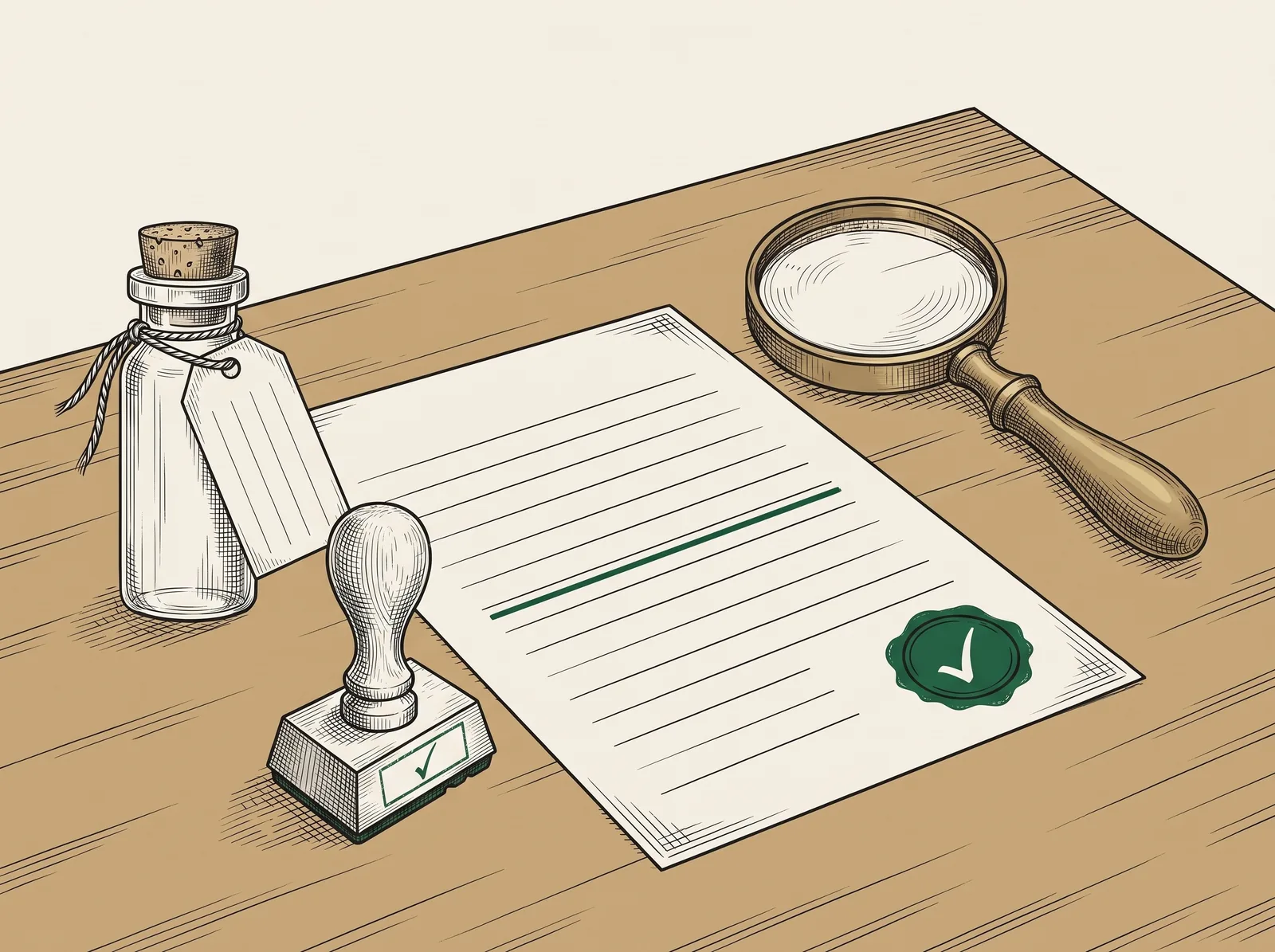
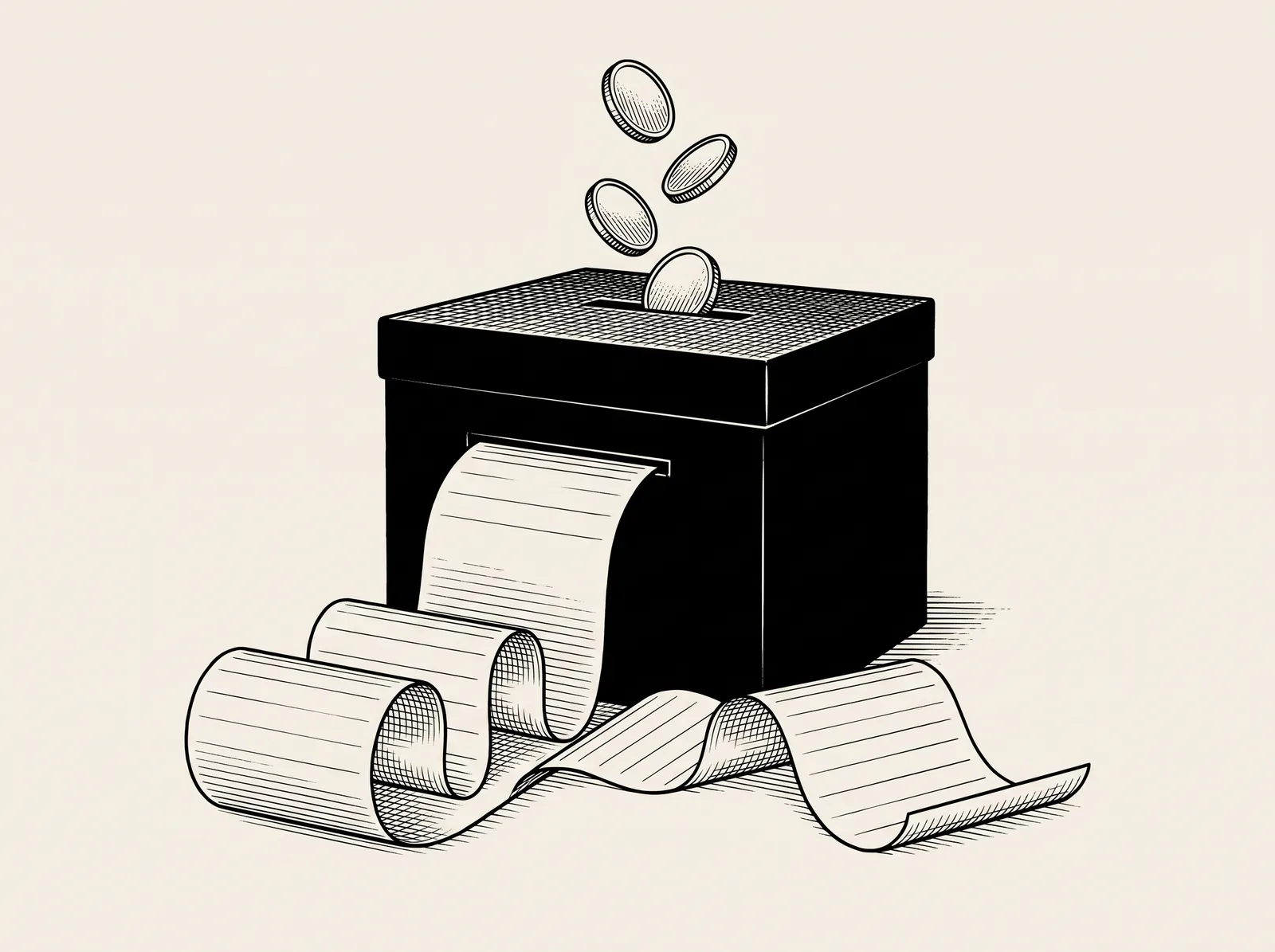
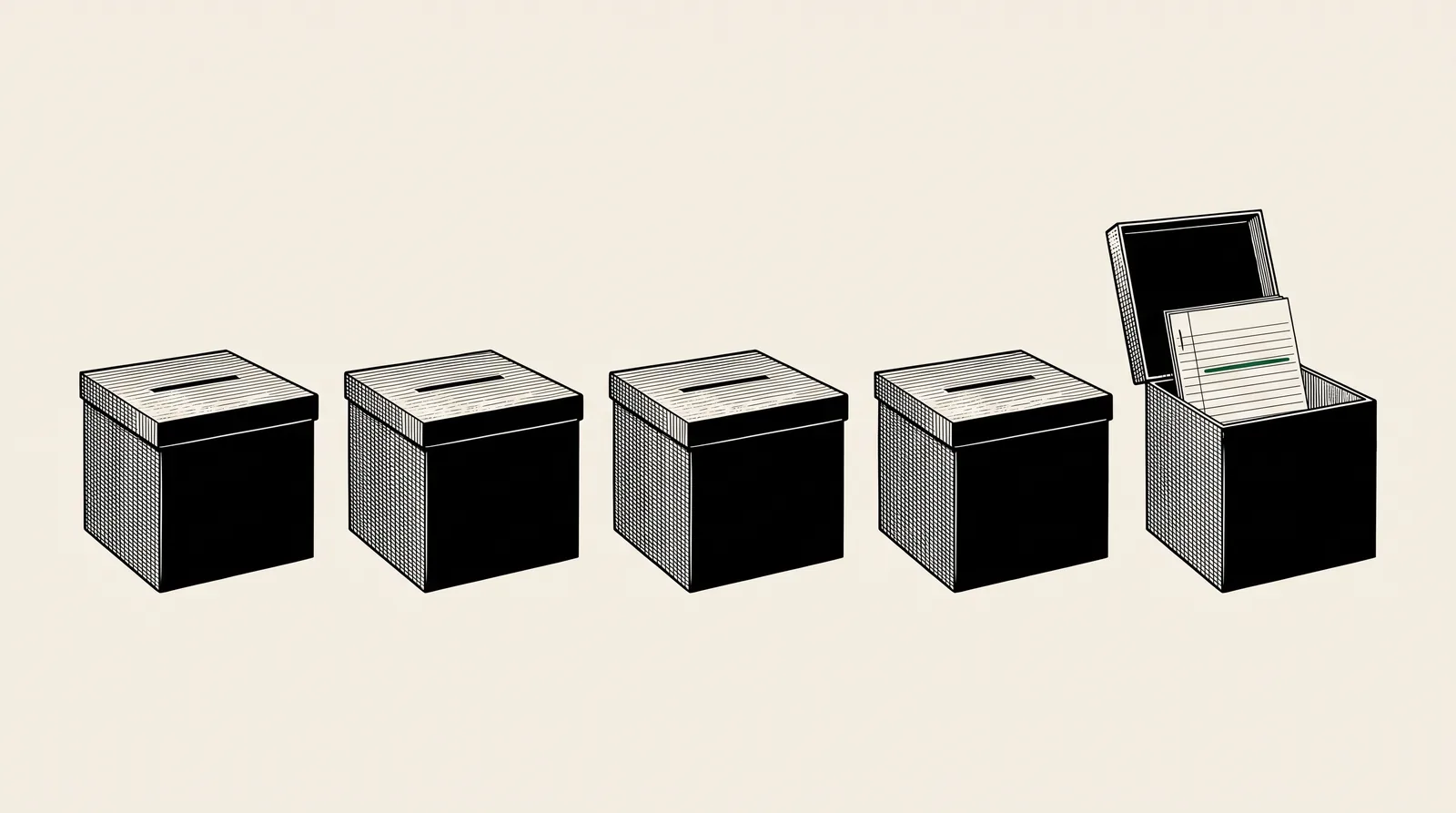
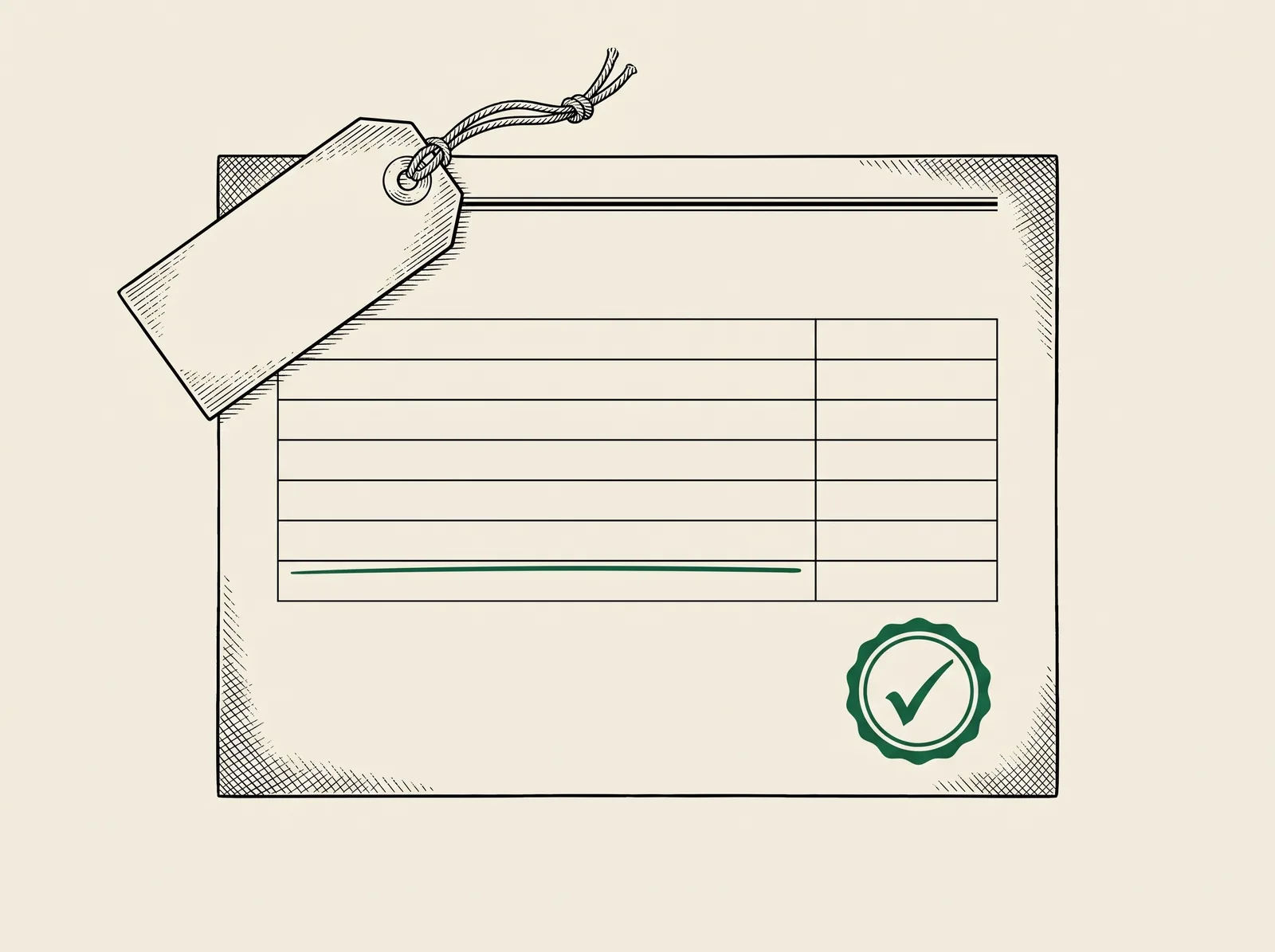
A rubber stamp, a sample vial with a blank tag, a brass loupe, a curled till receipt, a stapled stack of ruled pages with one line underlined, and a closed black box with a slot. Each one is a noun on the website: the stamp is the verdict, the vial is the sample, the loupe is the check, the receipt is the bill, the pages are the source, the box is every other tool.
- Engraved technical illustration, 1950s laboratory manual plate. Fine black line, crosshatch shading. No cartoon, no photoreal.
- One accent: deep green #1C6A45, only for a seal impression and one underline. Brass and wood are allowed as washes because the objects are brass and wood.
- Flat background #F3EEE4, said three ways: zero texture, zero gradient, no shadow on the background.
- No people, no hands, no readable text, no letters, no numbers. A seal is a circle with one check mark. A label is a blank ruled shape.
- Nothing cropped. Generous margin on every side. Objects separated by visible gaps of background.
- Every scene is built only from the objects on the two sheets, passed in as image references.



The rule was torn down from fingerprint.com on 10 September 2026: thirteen animations on their home page, eleven run once on entry in under a second, only two repeat and both are small. So here: a block fades up once when it arrives; a receipt draws itself in once, 700ms, staggered by line; the hero reader types one real receipt in about three seconds and stops. At most two things move forever on a page, and both are small: the cursor on the line being read, and a dot on a job that is really running. The film plays once. Reduced motion turns all of it off.
#f3eee4
#16140f
#1c6a45
#a08a5a
Google Fonts · SIL Open Font License 1.1
variable weight, opsz axis. Italic axis loaded. calt and liga off, so the letterforms stay engineered.
Google Fonts · SIL Open Font License 1.1
400, 500, 600. Ligatures off. Owns every eyebrow, every quote, every number in a table.
The copy
Where the words come from, the tells that were cut, and every headline beside the draft it replaced. The site ships the right-hand column. Nothing on it is invented.
The reader is one person: a 34-year-old who owns a 6-person US outbound agency and resells data they cannot see inside. The research names the pain The Black Box Tax.
The register, since 10 September 2026, is a plain product voice: short declarative sentences, the product as the subject, no first person, no adjectives that cannot be measured, no claimed certainty, and the work graded downward in public. It is written for a buyer who has never heard of Assay and is deciding in under five minutes.
The structure is seven blocks: the problem, the idea, the offer, the one thing nobody else does, the promise, the mechanism, the proof. The mechanism has a name, The Receipt Rule, and the page leads with what it does and with a number that goes against the product, because a market at stage 3 does not believe a promise.
Every visible line on the site is run through the linter, which strips tags and scores only what a visitor can read: five points, one off per group hit, and a build that fails below five. The number-plus-noun check is deliberately noisy, because a false positive costs ten seconds and a false negative is a claim nobody can back. The draft column below is what a first pass produced on 9 September 2026. It scored 2 of 5. The shipped column scores 5.
A market at stage 3 has heard every promise. A number that goes against you is the only one it believes.
A promise is a claim. A mechanism is a thing the reader can picture failing, which is why they believe it.
A logo row implies a relationship. A run the reader can open and check is a fact.
Every unsaid limit becomes a refund. Four limits, said first, are the cheapest sentences on the page.
The pain in the research is a bill that swings 30 to 50 percent. So the price is one number, and the headline says so.
Assay is not just another enrichment tool, it's a new way to prospect. Whether you're a solo operator or a growing agency, seamlessly turn any list of websites into verified, actionable insights.
Press it, then open the Website tab. Every marked line is rewritten in place with its draft and outlined in red. Press it again and the shipped words come back. The layout does not jump either way.
12 lines